Programmatic advertising has never lacked data. What it often lacks is direction.
Marketers today operate in an environment rich with data points: audiences, formats, metrics, and reports, yet many still struggle to make confident decisions while campaigns are live. With the onset of AI-powered insights, marketing teams are now able to interpret data inputs in a timely fashion with more accuracy, helping them act with confidence while performance is still unfolding. For broader industry perspective on AI adoption in marketing, see Harvard Business Review and Gartner.
By the time marketing teams understand what influenced performance, the opportunity to act has often passed. Budgets are spent, learnings are documented, and the same questions resurface in the next campaign.
This delay pushes optimization into a reactive cycle, where adjustments are made based on incomplete cues rather than timely, decision-ready insight.
Where uncertainty shows up
Across campaigns, similar constraints appear again and again:
The gap between audience size and addressable reach
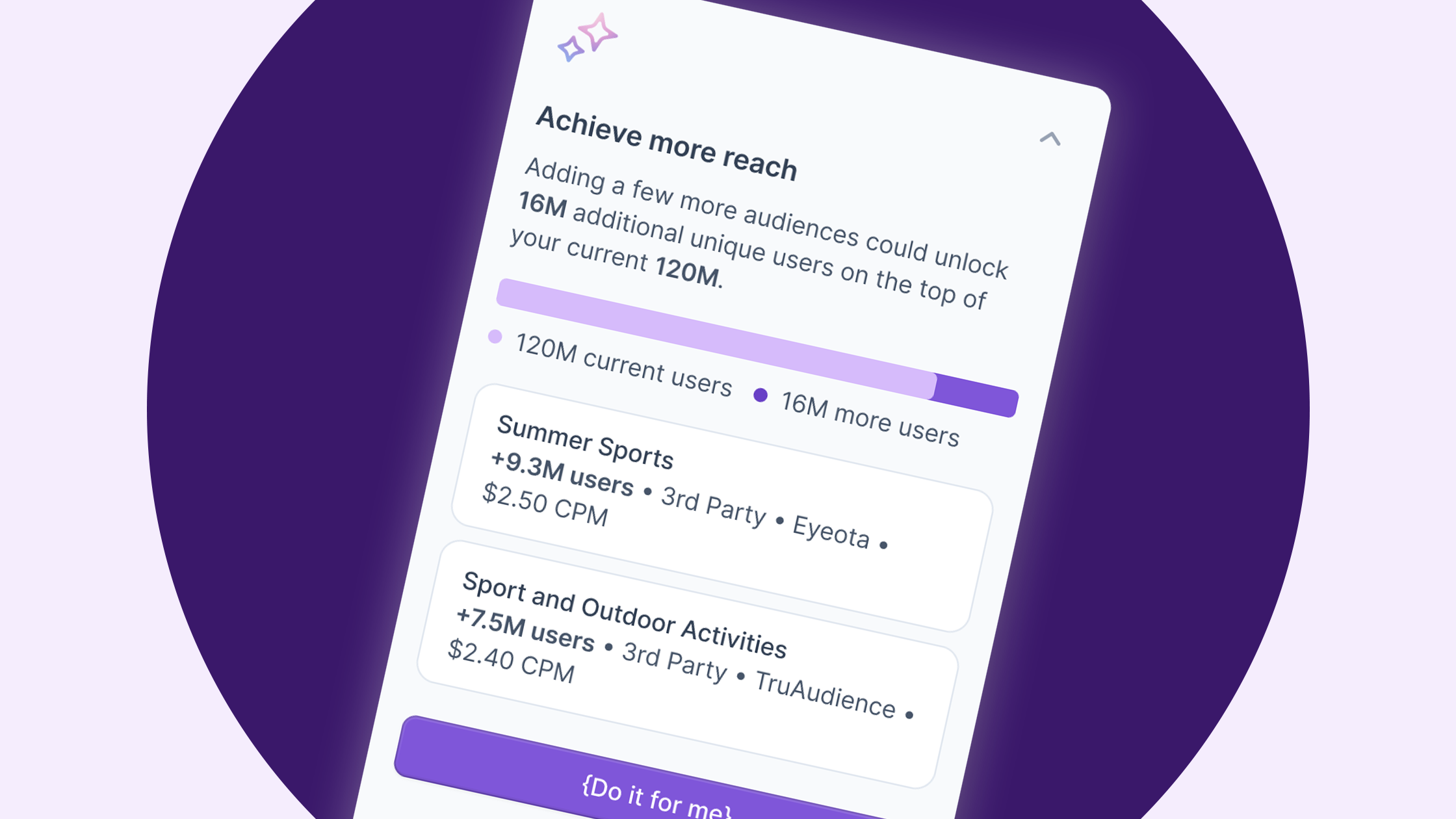
Marketplaces offer countless segments, but identifying the right ones becomes complex, especially when layering in additional targeting. For example, an audience may be listed at 5M users, but when campaign constraints are applied, the truly addressable reach can shrink to a small fraction of that number. Without visibility into that adjusted reach, planning decisions are often based on scale that isn’t actually attainable. With AI-powered insights, it can estimate a team’s true reach and realistic scale before they commit budget.
The gap in creative selections
Missing sizes, formats, or durations limit bid opportunities. These gaps often go unnoticed until performance stalls, leaving scale and efficiency on the table. Furthermore, without creative insights, campaigns may miss opportunities to engage the right users simply because the necessary creative assets are not in place. AI can now show you where your ads are missing opportunities, flag when creative is starting to wear out, predict which formats will perform best in different placements, and suggest new sizes or formats to unlock more reach, all while the campaign is still running. See eMarketer and Adweek for more information.
The gap in conversion visibility
Marketers see conversions occur, but lack a clear understanding of which combinations of touchpoints, channels, and tactics influenced outcomes along the way. When these indicators aren’t visible, optimization becomes slower and more cautious, not due to lack of expertise, but lack of actionable direction.
Why optimization needs clearer direction
In fast-moving campaigns, delayed insight creates hesitation. When teams need to dig through reports, decisions are often postponed or defaulted to standard practice rather than the most impactful ones. What marketers need isn’t more data or more dashboards, it’s guidance that helps them understand where to act while campaigns are still in the market.
How AI-powered insights change the equation
illumin Insights is an always-on intelligence layer embedded directly within the Canvas, your campaign building space, designed to reduce guesswork in everyday optimization. Rather than relying on reports or manual research, it analyzes live campaign data to surface incremental unique reach opportunities, creative coverage gaps, predictive performance signals, bid density shifts, and the paths users take before converting. Audience Insights analyzes the third-party audiences within a tactic and recommends contextually relevant segments aligned with current targeting and budget. Creative Insights highlights missing sizes or formats that limit other bid opportunities and flags creative fatigue trends, while Paths to Conversion provides a visual view of how touchpoints work together across campaigns and channels to drive conversions.
By embedding these signals directly into the campaign experience, illumin’s AI-powered Insights shifts from observation to action. Teams can expand reach through contextually relevant audience recommendations, recover missed bid opportunities caused by creative gaps, and better understand which sequences influence conversion, all while campaigns are live. The objective isn’t more reporting, but clearer direction at the moment decisions are made.
This shifts optimization from assumption-based adjustments to decision-ready action, guided by real-time performance indicators that reflect how campaigns are actually performing in the market. For example, a national retailer running a seasonal promotion might see that certain audience segments are driving higher in-store visits while others are underperforming. Instead of waiting until the campaign ends, the team can reallocate budget toward higher-performing segments or expand into contextually similar audiences while the promotion is still active.
Looking ahead
Programmatic performance depends on timely tactical adjustments. illumin’s AI-powered insights are built to guide decision-making during execution, helping teams refine targeting, improve creative coverage, and reallocate budget in response in real-time. Insights delivered after the fact may explain results, but it can’t influence them. Because the most valuable insight isn’t the one that explains performance after a campaign ends. It’s the one that helps you decide what to do next.
About illumin
illumin is a strategic advertising platform focused on improving how programmatic campaigns are planned, executed, optimized and measured. By reducing fragmentation across workflows, illumin supports in-market decision-making across the open web. Headquartered in Toronto, Canada, illumin serves brands and agencies across North America, Latin America, and Europe. For more information, visit https://www.illumin.com.
See More. Achieve More.